 |
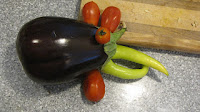
| Yard work at the family estate |
After leaving Claymont Community we decided to take a bit of a farming break, and visited Randy's family in Massachusetts. During our month off, Holly went down to New York for a few days to visit with old friends, and Randy went to a board game convention in Indiana called Gencon. While Randy was at Gencon, Holly was able to go back to St. Louis for a few days and see her family.
 |
| Egyptian-themed dinner |
 |
| Grillin' with Dylan |
 |
| Celebrating Holly and Grace's birthdays |
 |
| Genconners |
 |
| Visiting Tower Hill |
 |
| Stories for the niece |
 |
| Eager to dig in to some roast rabbit |
Refreshed and missing the smell of soil and the feel of fields, we packed up and set off, this time for
Coggeshall Farm Museum in Bristol, Rhode Island. Eager to make a good impression, we showed up late in the afternoon on Friday, just in time to take Saturday and Sunday off. We did arrive in time to help muck the barn, and meet the animals.
 |
| Jonny dishes out the real bacon |
Coggeshall Farm Museum is a restored tenet farm from the 1790s. What sets it apart from other historical sites is that no one famous or rich ever lived on the premises. Because it was a rental property, no one bothered to remodel the house, and it has stayed almost completely unaltered since the 1700s. The farm museum project began in 1968 when the Bristol historical society decided to save the house from demolition.
Jon and Shelley have been the farm managers for two years, and they, along with a few other paid staff and volunteers, facilitate the smooth operation of the museum. Both Jonny and Shelley have many years of historical interpreting under their belt, and met while working at Plymouth Plantation. In addition to interpreting, Shelley also plays the harp at weddings, and is a talented and sought after musician. We loved listening to her practice, including the occasional harp renditions of modern hits such as "Paint it Black" by the Rolling Stones. Jonny is a great storyteller, and often regaled us with his historical and agricultural knowledge. He is also an amazing cook, and we were treated to such delectable dinners as goat and chickpea stew, pasta with pesto and scallops, leg of mutton, and roast rabbit.
 |
| Visitors enjoying Breakfast in the Barnyard |
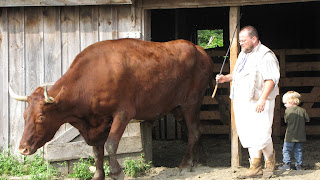 |
| Bo going to meet his fans |


The museum has a wide array of heirloom vegetables and heritage breed livestock. Coggeshall Farm is open to the public six days a week, and visitors enjoy interacting with the chickens, turkeys, geese, sheep, and cows. Workshops also play a large part in the museums' education, and on Saturday we tagged along for the Breakfast in the Barnyard tour. This is a popular program created by Shelley and Jonny that allows families to be a part of morning chores, culminating in Johnny cakes for all. The program draws as many as 80 people, and Jonny is great at engaging large groups, and keeping everyone interested. It's always fun to see kids get excited about farming. Not only were they eager to gather eggs, but also psyched to carry firewood or simply find a feather on the ground. Parents also joined in the fun, and snapped plenty of pictures of their kids with armloads of hay. After gathering eggs, the kids got to brush the horse, donkey, and cows, including the 1800 lb ox Bo. All of the animals were gentle enough to be trusted around kids, thanks to the constant efforts of Jonny and Shelley. By interacting with the animals on a daily basis they ensure they remain accustomed to people. Jonny and Shelley even managed to raise four goslings into pleasant, non-territorial geese.

 |
| This tree formed a cavernous room |
|
|
|
|
|
|
 |
| Holly likes rocks |
After Breakfast in the Barnyard ended, we went for a walk and found the beach at Colt State park, which was about ten minutes from the farm. We went swimming, and as we relaxed by the bay, contemplated how every farm should have a neighboring beach. We ended our lazy Saturday by holding a new batch of baby chicks, imprinting them to humans to ensure their docility. We learned that the key to imprinting poultry is to frequently spend time with them for the first four weeks, establishing a parental role. Then, however, it is important to back off, so that they don't start seeing you as a rival chicken.

On Sunday there was a special picnic for museum members, after which we got to enjoy a historically correct, hearth-made meal of squash and beans from the garden, gingerbread, leftover Johnny cakes, and salt pork (meat from last year's pig, soaked in a wooden barrel of brine for the last nine months).
 |
| The geese had a habit of ganging up on inanimate objects. |
An important part of the museum's labor force is local volunteers, and on Monday a horde of freshman from Roger Williams University arrived to help out. There were 40 freshman, 3 farm employees, and us, so in order to most effectively utilize the workforce we were each given a crew of 10, while Jonny oversaw the entire operation. Randy's crew made a fence around the chicken coop and cleared brush, while Holly's group had the difficult task of rearranging the hay in the hay barn in preparation for the next cutting. The freshmen were good workers and saw their tasks to completion, even though they had simply been given a random "community service project," and some of their peers had been sent to much less arduous assignments.

For the rest of the week we did garden maintenance for two gardens, the first being the museum garden which is historically accurate both in its contents and layout. Shelley also tries to use only historically accurate tools and methods of pest control. The second garden is Jonny and Shelley's personal modern garden where they are free to experiment with modern organic methods. One of these methods Shelley was trying was growing potatoes in a 3'x4' potato box. The idea builds on the concept of hilling potatoes; in theory, if dirt is continually built up around the plant, it will keep producing potatoes, even to the height of 4'. Shelley tried it last year, but her first attempt did not hold up through the season, and she wanted a sturdier box. It took us a few days, but in the end we had an impressive box with removable slats.
 |
| First haircut of the trip |

We started our next day off by shearing Randy's tangled mane. Then we went to a local historical carousel that Jonny and Shelley recommended. Located in Riverside, RI, the Crescent Park Carousel was originally the showcase model for a local carousel manufacturer in 1895. Every unique animal is hand carved and has real horsehair tails. The organ was brought over from Germany, and is also an antique. We learned that a carousel's original purpose was to test the skill of the riders by having them jab a miniature lance through a small metal ring on their way past. This tradition transformed into riders grabbing rings from a stationary dispenser, a rare option on today's carousels, but still alive and well at Crescent Park.
 |
| Randy triumphantly displays his quarry |
This is not a skill to be scoffed at, as this activity involves leaning a good four feet over your animal and catching your finger in a ring about three inches across, all while traveling a little over nine miles an hour. After we regained our land legs we headed towards Providence, stopping at yard sales and thrift stores on the way. Randy had spent a few years living in Rhode Island's capitol city and enjoyed showing Holly a few of his favorite haunts; including Cellar Stories, the kind of secondhand bookstore with vaguely organized floor-to-ceiling stacks of interesting reads and Sicilia's Pizzaria (try the stuffed pizza!). We ended our day by enjoying Waterfire, an event on the Woonasquatucket, Moshassuck, and Providence rivers celebrating local creativity.
 |
| Waterfire |
A hundred braziers are lighted on the surface of the river, while music, performers, and booths line the banks.
 |
| Haying with the help of a feral Lincoln |
 |
| Holly secures the load |

The next day it was time to bring in the baled hay that had been drying in the fields for a few days. Jonny, ourselves, and Clark, one of the museum staff, piled into the pickup truck and headed to the hay fields. With Clark and Randy picking up the bales and tossing them into the truck for Holly to stack, while Jonny drove, we were able to get between 40 and 60 bales per trip. Six hot, sweaty, itchy hours later we had over 400 bales of hay stacked in 2 hay lofts, enough to feed the animals through the winter with some left over. We were all ready for a break, and as Jonny pointed out, there is nothing more refreshing than a post-haying beer.

Our next big project was ripping out the decaying floor of the chicken coop and installing a rat-proof replacement. We learned that you cannot replace one aspect of a 20 year old shed without affecting everything else. We measured the floor at least eighteen times, and every time we put one piece in it changed the measurements of the next piece, meaning we also had to cut and re-cut every piece of wood several times. After four days of work, we finally had new floor joists, a subfloor, a layer of wire, and then the flooring. Jonny and Shelley helped us finish up the project, and after putting in roosts, fixing a window, and securing the door, the chicken coop was good as new.
 |
| The chickens were very helpful |
 |
| Our finished coop |
While we were putting in the subfloor, the remains of Isaac swept through, dumping eight inches of rain in two hours. We thought we'd stay dry while working in the coop, until we noticed water seeping up through our new floor. Before we knew it the coop was sinking faster than the Gaspee, and we had to abandon ship. We decided to brave the monsoon to grab raincoats to stay dry and shovels to dig a drainage ditch. The barnyard had become one big pond, and halfway to the house we were already drenched, and realized the raincoats were a lost cause. Our plan worked, and the chicken coop was soon above sea level and drying; the same could not be said for our "waterproof" boots.
Another byproduct of the storm was the flooding of the Cabriolet. A good rule of thumb for convertibles is that for every role you have in the roof, you should have one in the floor. Otherwise you end up bailing water out of the bottom with a milk jug and towels.

With our visit coming to an end, our last day was spent packing, cleaning, and taking their canoe out for a spin. After we got back from our row, Jonny and Shelley took us out to their favorite restaurant, the Beehive, which uses local and organic ingredients. Everything was crazy good, and we had a lovely, leisurely dinner. Right about the time were loosening our belts and trying to figure out how to stand up, they mentioned "so we really come here for the desserts," which were equally incredible. It was a perfect end to a wonderful visit.
 |
| Holly has difficulty with the drop spindle |
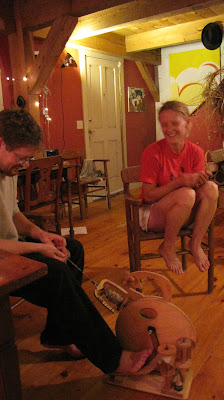 |
| Getting a spinning lesson from Shelley |
 |
| Randy, Holly, Shelley, and Jonny with Frankie |
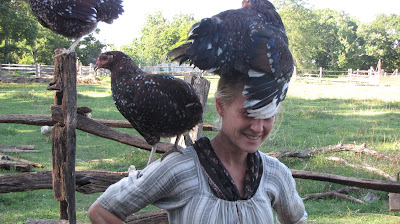 |
| Shelley and her affectionate chickens |
 |
| Randy enjoys weekly visits to NEGG, the local gaming group |


 The museum has a wide array of heirloom vegetables and heritage breed livestock. Coggeshall Farm is open to the public six days a week, and visitors enjoy interacting with the chickens, turkeys, geese, sheep, and cows. Workshops also play a large part in the museums' education, and on Saturday we tagged along for the Breakfast in the Barnyard tour. This is a popular program created by Shelley and Jonny that allows families to be a part of morning chores, culminating in Johnny cakes for all. The program draws as many as 80 people, and Jonny is great at engaging large groups, and keeping everyone interested. It's always fun to see kids get excited about farming. Not only were they eager to gather eggs, but also psyched to carry firewood or simply find a feather on the ground. Parents also joined in the fun, and snapped plenty of pictures of their kids with armloads of hay. After gathering eggs, the kids got to brush the horse, donkey, and cows, including the 1800 lb ox Bo. All of the animals were gentle enough to be trusted around kids, thanks to the constant efforts of Jonny and Shelley. By interacting with the animals on a daily basis they ensure they remain accustomed to people. Jonny and Shelley even managed to raise four goslings into pleasant, non-territorial geese.


 On Sunday there was a special picnic for museum members, after which we got to enjoy a historically correct, hearth-made meal of squash and beans from the garden, gingerbread, leftover Johnny cakes, and salt pork (meat from last year's pig, soaked in a wooden barrel of brine for the last nine months).

 For the rest of the week we did garden maintenance for two gardens, the first being the museum garden which is historically accurate both in its contents and layout. Shelley also tries to use only historically accurate tools and methods of pest control. The second garden is Jonny and Shelley's personal modern garden where they are free to experiment with modern organic methods. One of these methods Shelley was trying was growing potatoes in a 3'x4' potato box. The idea builds on the concept of hilling potatoes; in theory, if dirt is continually built up around the plant, it will keep producing potatoes, even to the height of 4'. Shelley tried it last year, but her first attempt did not hold up through the season, and she wanted a sturdier box. It took us a few days, but in the end we had an impressive box with removable slats.

 We started our next day off by shearing Randy's tangled mane. Then we went to a local historical carousel that Jonny and Shelley recommended. Located in Riverside, RI, the Crescent Park Carousel was originally the showcase model for a local carousel manufacturer in 1895. Every unique animal is hand carved and has real horsehair tails. The organ was brought over from Germany, and is also an antique. We learned that a carousel's original purpose was to test the skill of the riders by having them jab a miniature lance through a small metal ring on their way past. This tradition transformed into riders grabbing rings from a stationary dispenser, a rare option on today's carousels, but still alive and well at Crescent Park.


 The next day it was time to bring in the baled hay that had been drying in the fields for a few days. Jonny, ourselves, and Clark, one of the museum staff, piled into the pickup truck and headed to the hay fields. With Clark and Randy picking up the bales and tossing them into the truck for Holly to stack, while Jonny drove, we were able to get between 40 and 60 bales per trip. Six hot, sweaty, itchy hours later we had over 400 bales of hay stacked in 2 hay lofts, enough to feed the animals through the winter with some left over. We were all ready for a break, and as Jonny pointed out, there is nothing more refreshing than a post-haying beer.
 Our next big project was ripping out the decaying floor of the chicken coop and installing a rat-proof replacement. We learned that you cannot replace one aspect of a 20 year old shed without affecting everything else. We measured the floor at least eighteen times, and every time we put one piece in it changed the measurements of the next piece, meaning we also had to cut and re-cut every piece of wood several times. After four days of work, we finally had new floor joists, a subfloor, a layer of wire, and then the flooring. Jonny and Shelley helped us finish up the project, and after putting in roosts, fixing a window, and securing the door, the chicken coop was good as new.


 With our visit coming to an end, our last day was spent packing, cleaning, and taking their canoe out for a spin. After we got back from our row, Jonny and Shelley took us out to their favorite restaurant, the Beehive, which uses local and organic ingredients. Everything was crazy good, and we had a lovely, leisurely dinner. Right about the time were loosening our belts and trying to figure out how to stand up, they mentioned "so we really come here for the desserts," which were equally incredible. It was a perfect end to a wonderful visit.


