|
| Pizza makin' |

The next morning we dashed back to Taft Hill Farm bleary-eyed and ten minutes late. Everyone was surprised to see us, because apparently spending an evening with Brian and Naz usually results in spending the next day recovering. Although a little down time would have been appreciated, we dove right into a full day's work, with the thought of pizza that night driving us. Around 4:00 we all headed down to the West Townshend Country Store. This was the first pizza night to occur in the rain, and everyone was curious as to what the turn out would be. We needn't had worried, as by the end of the night we had made about 40 pizzas. West Townshend Country Store supplied the dough, sauce, cheese, and a few toppings, and customers were encouraged to bring their own unique toppings. These included local sausage, local cheddar cheese, chicken-of-the-woods mushrooms, and pesto. Robert manned the pizza oven, while Holly, Randy, and another volunteer rolled out the dough and topped them with sauce and cheese. After eating our fill of pizza, and helping to clean up, we headed home for a good night's sleep before the Harvest Festival the next day.
 |
| Our mountain of cider apples |
 |
| Dan and Randy beginning |

Preparations for the Harvest Festival began early Saturday morning. The Harvest Festival was Jamie's brainchild, and she had been busy doing almost all of the planning and prepping in the weeks leading up to it. She gathered hay for the scarecrow-making activity, loaded up Robert's antique cider press to bring down, picked up pumpkins for the pumpkin carving, packed up Robert's maple syrup and glass-blown pumpkins for the Taft Hill booth, and unloaded the pickup load of apples. Right away we began tackling the mountain of apples, transforming them into gallons and gallons of cider. After a few hours, Holly helped roll out dough at the pizza oven for the lunch rush, which lasted from about 11-2. People were excited to see the pizza oven up and running on a Saturday, and happily munched their pizza as they took in the Harvest Festival. The pumpkin-carving and scarecrow-making contests were quite successful. Some clever kids made Obama and Romney scarecrows in anticipation of the upcoming election. Next to our cider pressing operation was the
Vermont Quince booth, a relatively new company that is bringing back the once-popular fruit, and sharing the joy of quince. They were quite generous with their samples, and our eyes were opened to the versatile, delicious pome. Besides making excellent jellies, pastes, and splashes, quince, with its high pectin content, was also used historically to set jellies. Vermont Quince does not have a mature orchard yet, so they have to scour the Northeast to find sources of this forgotten fruit, sometimes driving as far as Pennsylvania to pick from a few trees.
As the sun began to set, the festival started to wind down. Tired and sticky, we were still only three-quarters of the way through the apple heap. We kicked it up a notch, and threw the last apples into our 42nd hand-cranked gallon just as darkness closed in around us. Our 11-hour work day ended with us throwing everything in the pickup truck to deal with the next day.
 |
| Creative Jack-O-Lanterns |
 |
| Alex picking through the apple pile |

We got word of a local shindig rumored to be a rollicking good time, and as tired as we were we couldn't pass it up. Although we heard about it from Naz and Brian, even Robert and Cathy could attest to the gathering's unique atmosphere. After meeting up with Brian, Naz, and Dan, we headed over to the party. The driveway leading up to the isolated house meandered through the woods and was lined with cars for about a half of a mile. Upon entering the house, we found the rooms filled with boisterous party-goers, leaving only enough room to squeeze past single file. Like logs in a flume, we were carried along through the maze-like progression of rooms. The wall-to-wall people gradually thinned out as we delved/penetrated deeper into the unending rooms, and after passing root cellars and narrow, twisted stairways we came upon room after room boasting banquet tables littered with the detritus of a bygone feast. Hoping for a late-night snack, we were disappointed to find the pickings slim; the only remaining chips were the tailings at the bottom of the bowl, and the goat carcass looked like it had been skeletonized by piranhas. Noticing a slight flow of people in a different direction, we followed them into another wing and came upon a tightly packed room featuring a live reggae band. The party was still in full swing, but our long work days had finally caught up with us, and we decided to call it a night. Even the posters promising a 1:00 a.m. burlesque show were not enough to give us pause.
 |
| Glass hermit crab shell |

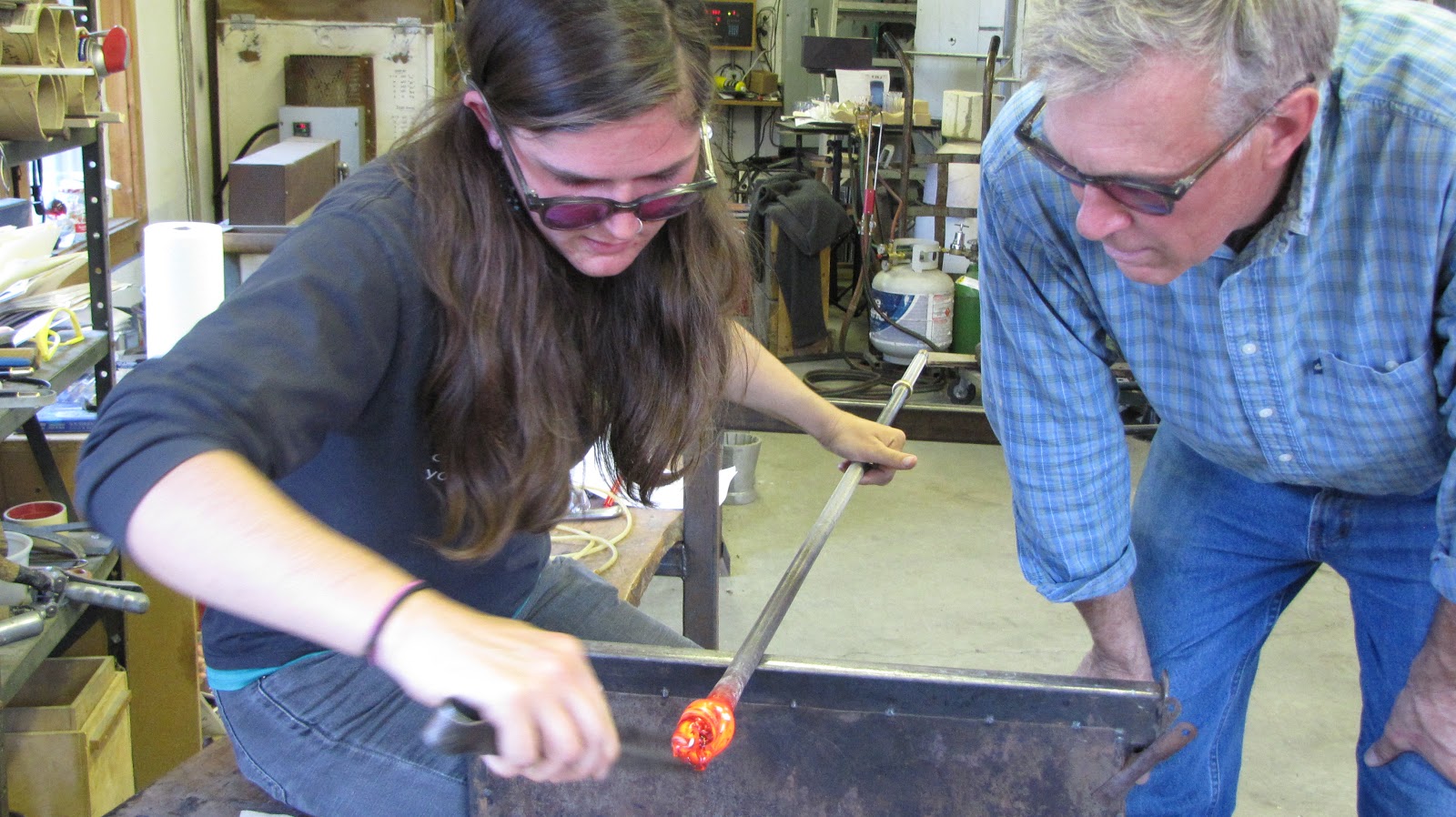
A few days later, Robert offered us an opportunity to try out glassblowing at his solar-powered studio. Robert has a large solar array which produces enough energy to keep his glass furnace at over 2,000 degrees. Along with having quite a diverse farm,
Robert is a prominent figure in the glass blowing community, having designed pieces for Tiffany's and the Dorchester in London; as well as designing awards for MTV, Nickelodeon, VH1, ESPN, the Country Music Awards and others. He also designed the current flame in the Statue of Liberty back in the '80s. Needless to say, we jumped at the opportunity to glean even a little knowledge of this craft from him.
Running a little late, we hopped in the car and sped off to meet Robert at his studio, about 5 miles away. Unfortunately, at the bottom of the long hill leading to the farm, the Volkswagen started bucking and coughing, and eventually died. After about ten futile minutes of attempting to start it, we trudged the mile uphill back to the farm. Slightly worried about the car, but more worried about missing our chance to blow glass, we jumped into the farm truck and continued on our way.

When we arrived, Robert was in the middle of making his signature transparent glass hermit crab shells. He gave us a crash course in glass working (we would not actually be using the blowpipe to make our paperweights) before getting us started. Using colors left over from Robert's glass pumpkins, we dipped, pulled, twisted, melted, and shaped our one-of-a-kind works of art.

Over the next few days the fate of our car weighed heavily on our minds. What we had originally thought was a simple lack of gas was not remedied with the gas Robert lent us, so we had the car towed back to the farm. After a week of tinkering in his spare time, Randy finally realized that the gas Robert had lent us had been mixed with kerosene. As much of a pain as it was to siphon the gas tank, we were relieved it was such an inexpensive fix.
 |
| A handblown hermit crab terrarium |
On Thursday we had the day off, and decided to explore nearby Brattleboro. Not breaking from our usual city-exploring formula, we located the food co-op, the thrift stores, and an art store. Brattleboro is a nice little city, and we especially enjoyed the fact that it had cell phone reception, unlike West Townshend and the farm.
 |
| The "glory hole" |
We still had several bushels of apples laying around that hadn't made it to the cider pressing, so one day Jamie and Holly decided to make a big batch of apple butter. Sweetened with Taft Hill maple syrup, it turned out quite delicious, even though one of the jars broke in the hot-water bath. It turned out great, and we enjoyed it on Jamie's homemade bread.
Jamie and Dan shared our enthusiasm for a good board game, and agreed to pick a game from Randy's stash. At the last farm, Randy had added another stack of board games to his ever-growing collection. Even while traveling he constantly scours thrift stores and yard sales for new games, and has about a dozen at any one time. Jamie chose a trivia game by Isaac Asimov, and we all had a good time learning predominantly science-based trivia from the 1970s (did you know that the only actual deaths in space were Georgy Dobrovolsky, Viktor Patsayev, and Vladislav Volkov in 1971?).
 |
| Frying up our mushrooms |
That weekend we set out with Robert to shore up the fences in the upper pasture in preparation for the arrival of the Randall Lineback heifer, which was being boarded at Meadow's Bee Farm. While tramping through the woods, we espied a cluster of oyster mushrooms, and later a bear's head tooth mushroom high up in a tree. Randy knocked down the bear's head tooth with a big stick, and that night we enjoyed a wild mushroom feast. They were some of the best mushrooms we'd ever had, though our judgement may have been a bit skewed since they were fried in bacon grease.
 |
| Making the innards outtards |
The next afternoon we headed over to Meadow's Bee Farm to observe a lamb slaughter. Brian and Naz were culling the herd, and since we hadn't processed any lambs yet we wanted to check it out. By the time we arrived they were almost done, only needing to detach the offal from the carcass. We still had a good time hanging out, and Leigh treated us all to a delicious lunch, including her delicious kale shakes.
Early one morning Jamie, Dan, and ourselves were awakened to the loud clatter of dishes hitting the floor. Everyone assumed it was someone else's early-morning clumsiness. However, later in the day we noticed nut shells on the floor, and realized the noise had instead been made by a sciurine intruder. Jamie and Dan took on the task of squirrel-proofing the apartment, and making safe all future nuts.
 |
| Sushi night |

Monday found us scurrying around the farm in preparation for the imminent Hurricane Sandy. In 2011 Vermont was hit rather hard by Hurricane Irene, and no one was taking any chances this time. Over fifty chickens were relocated to the barn aviary because their normal coops were possibly unable to withstand the strong winds. While we were corralling the peacock, we learned of a different peacock call than the one we were used to. Besides the hair-raising screech they make to attract mates, when aggravated they also produce a honking noise that wouldn't have been out of place on a busy street in the 1930s. After shooing the peacock into the barn, doors were screwed shut, windows were bolted, and the rest of animals were brought in early, as we all settled in to wait for the storm.
That evening the winds began to pick up, and grew into a blustery gale. Laying warm and dry in our bed we listened as Robert went outside to check on all the animals, and were glad that our farming responsibilities do not yet include hurricane patrols at midnight. Everyone took a hurricane day on Tuesday, holing up inside as the power flickered on and off. We took advantage of this time to work on our
blockprinting. We had almost been looking forward to "roughing it" if the power went out, but when it did for a few days Taft Hill's industrial-size generator kicked on immediately, so the outage wasn't even a blip in the house's daily routine. The hurricane did knock some limbs down, but all in all it wasn't that bad.
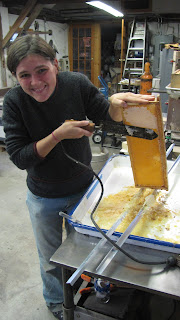

We were lucky enough to be present for Robert's honey harvest, and were able to help spin the honey out. First Robert showed us how he used a heated knife to cut the wax caps off of the honeycomb. Next the frames were loaded, four at a time, into Robert's antique honey spinner. A spout at the bottom of the honey spinner filled a large pot, and ultimately we got about three gallons of honey.

For Halloween we went over to Brian and Naz's with Dan. Our migrant farmer wardrobe limited our costume options, but at the last minute Holly came up with the brilliant idea to dress up as each other. Holly enjoyed having pockets big enough to put a book in, and by the end of the night Randy was glad to take out the itchy nose ring. As a special Halloween treat we used quince juice given to us by Vermont Quince, rum, limes, and mint to concoct delicious "quincejitos." While gathering ingredients, Holly lamented the fact that we didn't have any mint, but then she remembered that Naz and Brian live on a farm, which of course had five patches of it. Yay for farmer friends!

The next day was Randy's birthday. For his cake, Randy wanted to try a crazy cupcake-cheesecake confection. First we made both chocolate and vanilla cupcakes, then filled them with cream cheese icing, and baked them into a cheesecake.
Needless to say, it was a huge hit, and we should probably patent the idea
Friday morning we left, and as a delicious send-off, Jamie made apple-cheddar scones for breakfast. Randy needed to be in New Jersey for a game design conference that night, and Holly took the bus to Boston to visit with friends while Randy got his geek on.


 Bidding farewell to Holly’s family, we pointed our little red wagon back towards Coggeshall Farm in Bristol, Rhode Island. Much to Johnny’s amused chagrin, we again arrived late on a Friday afternoon. We had returned to partake in the traditional slaughtering workshop the following day, and when we showed up Johnny, Shelley, and Jeff the butcher were already busy “preparing” the sheep. One ewe had already been killed and cleaned, with three rams awaiting the knife. Jeff sat astride the ram, holding him, and as we watched he expertly and humanely located and cut both the jugular vein and carotid artery. The ram took less than two minutes to completely bleed out, but was unaware of the proceedings much sooner than that. The blood was collected in a bucket for blood sausage. Next Jeff made an incision from the base of the ribcage to the pelvis in order to remove the offal, or innards. As he gutted the sheep he also carefully removing the skin, which will be used as luxurious sheepskin rugs. They saved the lungs (or "lights"), heart, liver (after removing the gallbladder), stomachs, kidneys, intestines, testicles, and the head for various period recipes they wanted to try. During the organ harvest we learned about the caul fat, which holds the stomachs in place. It is a few square feet of lacy membrane with a network of fat deposits also known as "the chef's friend" because when draped over roasting meats it prevents drying out and adds a delicious fatty, lamby flavor. Randy helped Shelley wash out the stomachs, which was a smelly, time intensive job, but hopefully the haggis will be worth it. We also helped scraped the hides, removing any clinging bits of flesh, membrane, or fat. Two rams later it was well into the evening, and we were grateful to finally go inside and enjoy Johnny's delicious crockpot creation. Shelley and Johnny were happy to have us back, even though they would miss having leftovers.